

Arc'teryx
A faster, smarter storefront: +35% conversion
Work we led on the e-commerce storefront at Arc'teryx.
Context
Why this mattered
Over roughly two years, product listing pages (PLP) and product detail pages (PDP) stopped keeping up with what shoppers needed. Pages were buggy, search was limited, and the stack behind merchandising and discovery was outdated — which capped optimization and growth. Prioritizing a modern storefront wasn't a cosmetic refresh; it was about making PLP and PDP trustworthy surfaces again.
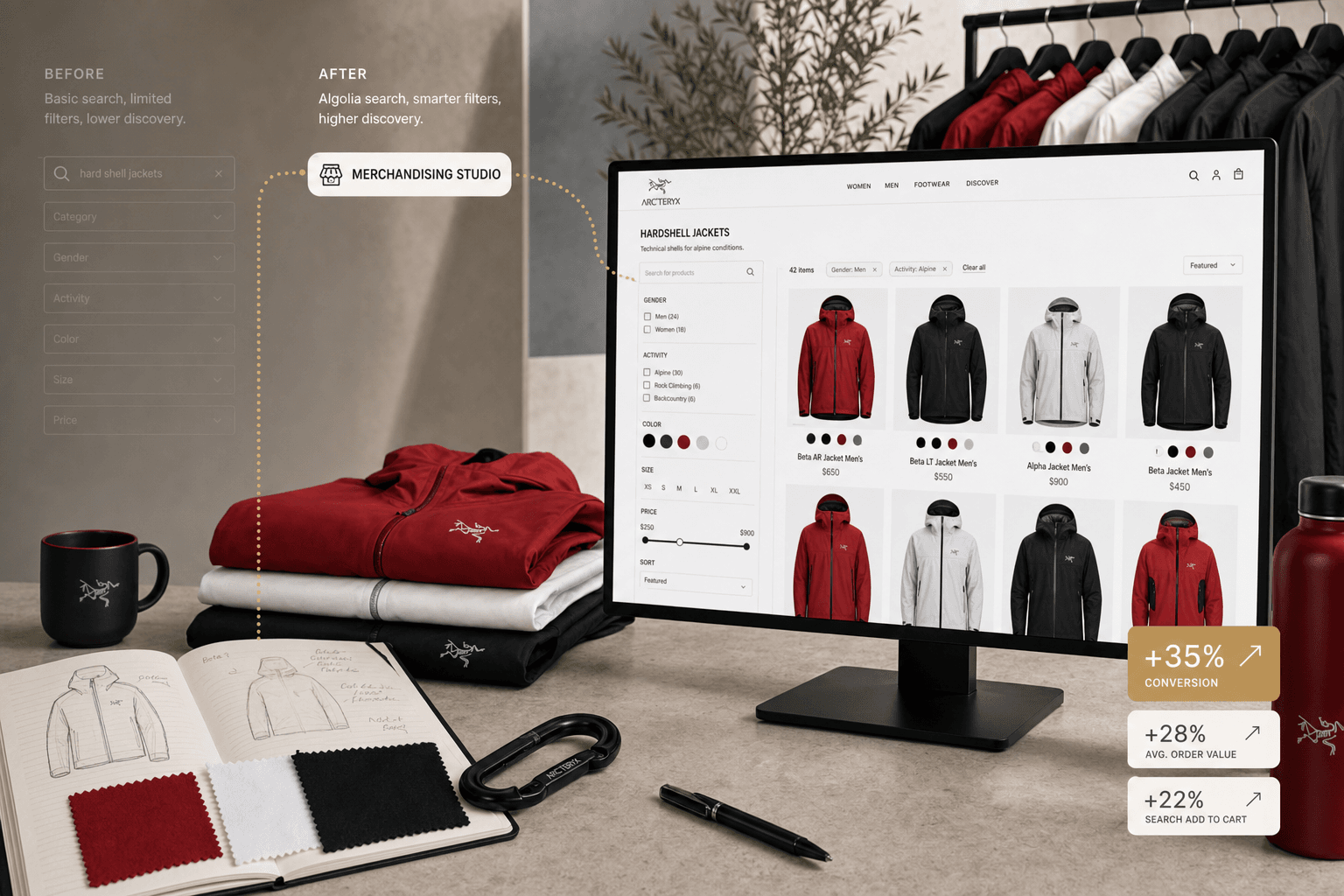

Snapshot
+35% conversion
Before-and-after traffic on PLP and PDP; conversion rate validated via tracked events.
- +35% conversion on PLP and PDP (before-and-after traffic)
- Search and merchandising foundations the team could iterate on
- Merchandising and search on separate, modern foundations — Fredhopper and Algolia
Before
The bottleneck
PLP and PDP weren't servicing the right information. Search functionality was constrained, experimentation was hard to run safely, and the experience hadn't kept pace with how technical apparel shoppers browse and compare. The team had data and intent — but not a foundation to iterate quickly.
What we did
How we approached it
We reworked PLP and the merchandising studio (Fredhopper) so categories, filters, and curated placements reflected how the business wanted to sell. Algolia powered search improvements — relevance, speed, and capabilities the prior setup couldn't match. UX research grounded a modern redesign, and we paired rollout with measurement so changes could be validated by tracked conversion events, not opinion.
Stack
Tools and platforms
- Fredhopper
- Algolia
Outcomes
What changed
We measured conversion on PLP and PDP using before-and-after traffic comparisons — conversion rate calculated from tracked events on those pages. The +35% lift reflects that period-over-period change on the surfaces we rebuilt, not a synthetic benchmark. Discovery became faster to improve: merchandising and search were separated cleanly, experimentation was possible again, and the storefront matched the brand's technical positioning.