

Best Buy
Reviews that sell: a 15% lift in PDP purchase rate
Work we led on the storefront and PDP team at Best Buy.
Context
Why this mattered
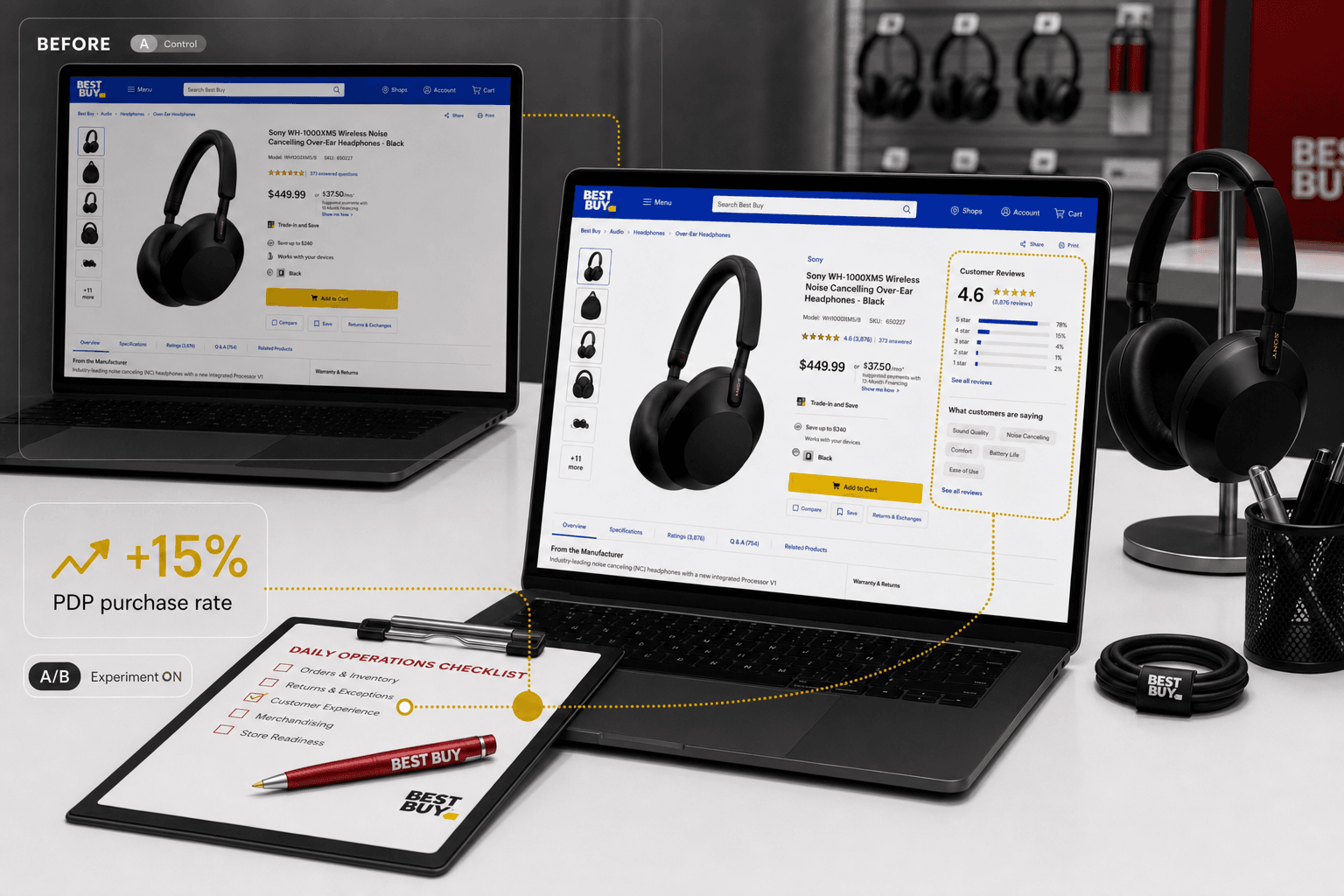
PDP traffic pointed to a missing step in the conversion journey. UX and Product interviewed customer samples and heard the same thing: shoppers wanted previous purchasers' opinions on the product detail page — not somewhere else in the journey. Serving reviews in the right part of the page, in a layout that worked for mobile users, became the priority. This was continuous delivery — not a one-off redesign.

Snapshot
+15% PDP purchase rate
Experiment on/off comparison on the analytics platform; validated before and after.
- +15% PDP purchase rate in experiment vs. control (feature on/off)
- Reviews placed where mobile shoppers actually decide
- Safer releases through A/B testing and feature flagging
Before
The bottleneck
Reviews existed in the data, but on the PDP they were buried, unorganized, and out of context. Shoppers couldn't find trustworthy social proof when they were ready to decide — and much of the information Bazaarvoice already captured never surfaced in the experience.
What we did
How we approached it
We owned the UX for how reviews appeared on the PDP, syndication rules and the processes behind them, and the measurement stack to prove what changed. We ran A/B tests and used feature flags for safer releases — so improvements could ship incrementally without betting the whole page at once. Bazaarvoice powered verified reviews and ratings; our job was to put them where they converted.
Stack
Tools and platforms
- Bazaarvoice
Outcomes
What changed
We measured lift through experiment on/off metrics on the analytics platform — comparing PDP purchase rate when reviews were surfaced correctly vs. the prior experience. The +15% result reflects that controlled comparison, validated before and after rollout. Reviews became a conversion lever at the decision point, especially on mobile.